
New patient information
What should I expect for my first visit?
1
You will receive a text message to confirm your attendance 48-72 hours prior to your appointment. Please provide a minimum 24 hours notice if you cannot attend your appointment to avoid being charged a cancellation fee.
It would be very helpful if you can complete our online medical history form prior to attending. The form can be found HERE.
Alternatively, please arrive 10 minutes before your appointment time to complete a medical history form once you arrive.
Patients referred for a consultation will be allocated a 30 minute appointment time. The endodontist will perform an examination of the tooth/teeth you were referred for, including taking any radiographs and/or cone-beam CT (CBCT) scans as necessary. Our consultation fees are inclusive of any radiographs that need to be taken (if required, CBCT scans will be taken and will incur additional fees). We will then discuss with you the nature of your problem, and treatment options and costs.
Is parking available at the clinic?
2
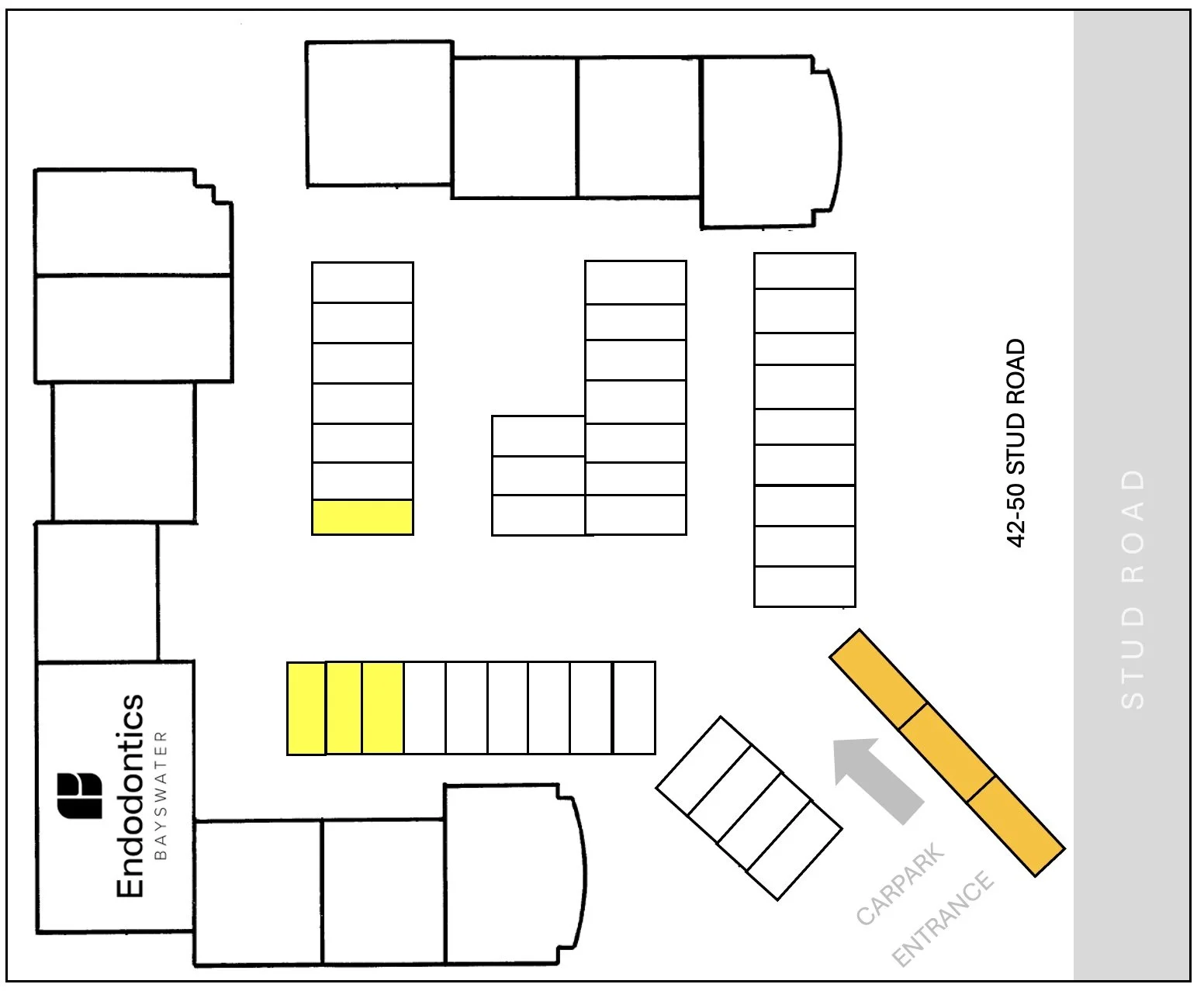
Dedicated parking is available for our patients. There are four bays set aside specifically for Endodontics Bayswater patients (marked in yellow) and three visitor bays (marked in orange). There is also lots of street-side parking near the clinic.
How can I get to the clinic via public transport?
3
You can get to Endodontic Bayswater via bus (route 664 running between Chirnside Park Shopping Centre -Knox Shopping Centre), stopping at the Phyllis Street-Stud Road stop which is located 250m from the clinic. Alternatively, Bayswater Train Station is located 1.3km away.
5
Do I need a referral to see you?
4
Why can’t my dentist do the root canal treatment?
We work closely with general dentists and other dental specialists, and most of our patients are referred in.
While a referral is not necessary to see us, our practice is limited to endodontic treatment and we do not provide general dental treatment (e.g., comprehensive dental examinations, dental cleans, crowns). If a crown is required after endodontic treatment, this will need to be carried out by a general dentist or a prosthodontist.
Dentists often perform root canal treatments. However, there may be cases where it is difficult to diagnose the cause of dental pain, or the treatment is more complex due to the anatomy of the tooth. The root canal system may be irregular or blocked by materials (e.g., previous root-fillings), or the tooth might be covered by a crown or a bridge.
Endodontists have undertaken years of specialised education and practice to gain the expertise and skill to manage these cases. We also have access to advanced technology such as the dental operating microscope and cone-beam computed tomography (3D-scans) to manage cases more efficiently and thoroughly.